
CALL US
 +91 9988887779 |
+91 9814255407
+91 9988887779 |
+91 9814255407
CALL US
+91 9988887779 |
+91 9814255407
The threaded flange (also called "bolted flange") style uses threads to connect the flange to the pipe. The end of the pipe is externally threaded and the hole in the flange is internally threaded. Then screw the male threaded pipe into the female threaded flange.
Available in a wide range of sizes and pressure ratings, the threaded flange design is primarily used for small piping systems. H. ≤ 4 inches. Also, its use is usually limited to non-toxic, low-pressure, and low-temperature systems. Threaded flanges in sizes 1/2" to 2" are much more common than sizes 2" and up. For low pressure applications, threaded flanges use only flat and raised surfaces. Not suitable for high temperature applications as the thread profile is distorted and often leads to leakage.
Read More
A socket weld flange has a socket into which the pipe is inserted. The tube is attached to the outside of the flange he hub by a fillet weld. A significant drawback of this type of flange is that the weld is difficult to verify and is not considered a high integrity joint. Socket weld flanges are therefore only suitable for low to medium grades (≤ ASME 600). Socket weld flanges are often flat or raised because they have poor integrity and are not suitable for high pressure applications.
The Socket Weld Flange is designed for small nominal pipe sizes (≤ 4 inches, ≤ 10 cm) and is common on ½ to 2 inch pipe sizes (1.3 to 5 cm pipe sizes). The mechanical strength of socket weld flanges is similar to slip-on flanges, but slip-on flanges can use two welds.
Read More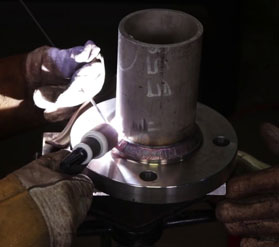
Industrial Plot No. B-4,
Focal Point, Mandi Gobindgarh,
Punjab 147301
+91 99888 87779
+91 76578 57407
+91 76579 57407
sales@asiaflange.com
jitensteels@gmail.com